
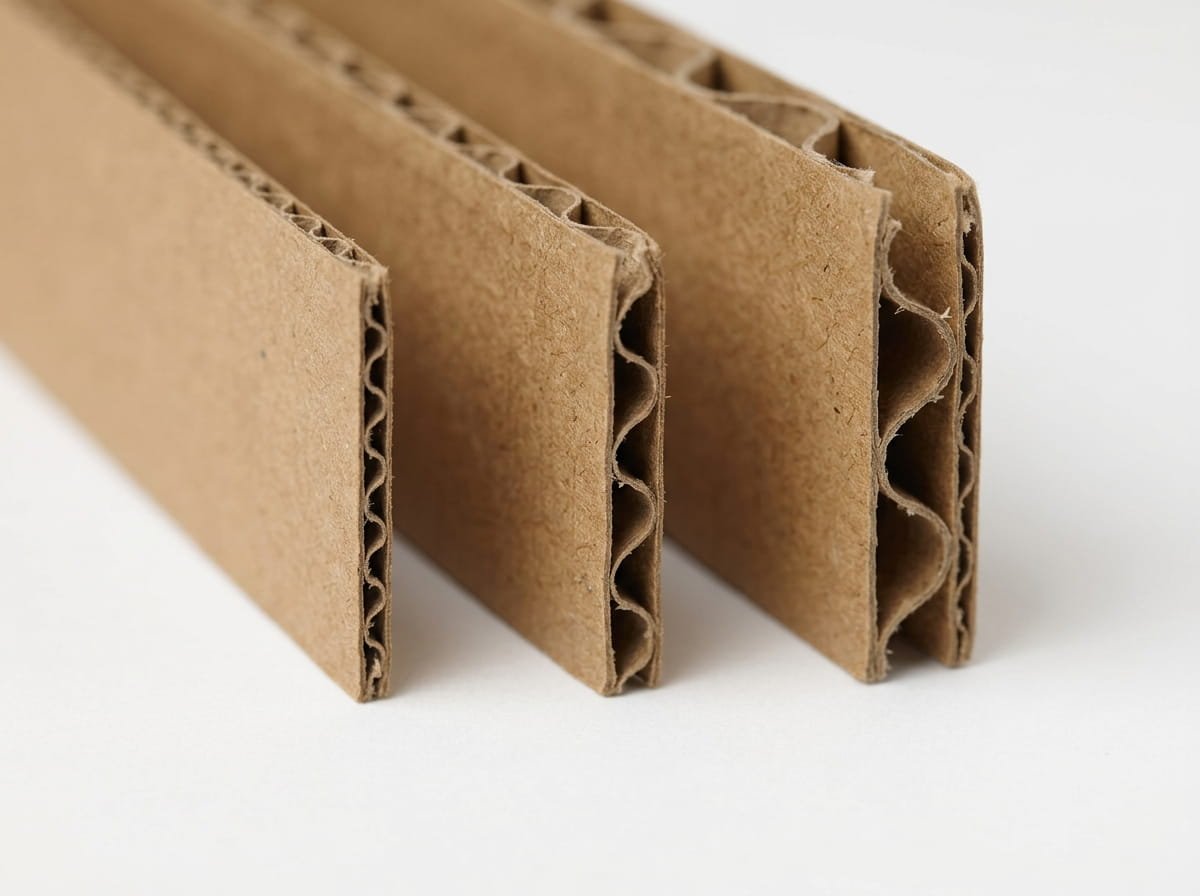
Corrugated flute types decide how strong your shipping boxes are, how sharply they print and how much they cost. Yet most buyers never meet the term until a supplier casually mentions B flute or E flute in a quote. Fortunately, once you understand what the letters mean, choosing a box becomes straightforward.
This guide explains flutes in plain English, compares the main options, and helps you match a board to your product and your delivery route.
What Is a Flute?
Corrugated board combines flat sheets, called liners, with a wavy layer in between. That wavy layer is the flute.
Think of the waves as a row of arches. They create air gaps that cushion knocks, and they resist pressure from above when boxes stack on a pallet. Consequently, a corrugated box protects far better than a flat sheet of similar weight.
Manufacturers name flutes with letters such as A, B, C, E and F. Interestingly, those letters reflect the order in which the industry developed them, not their size, which is why they never run neatly from large to small.
Single Wall, Double Wall and Triple Wall
Before you reach the flute letter, consider the number of layers.
Single wall uses one fluted layer between two liners. This covers most ecommerce boxes and retail shipping cartons.
Double wall uses two fluted layers and three liners. Therefore, it suits heavier goods, longer supply chains and products that get stacked.
Triple wall uses three fluted layers. Industry uses it for very heavy loads, although everyday retail products almost never need it.
The Main Corrugated Flute Types
Flute sizes vary slightly between manufacturers. Treat the thicknesses below as approximate, and confirm exact figures with your supplier.
A Flute
The thickest common flute, at roughly 4.5 to 5 mm. Those large waves deliver good cushioning and strong stacking performance, which suits fragile or bulky lightweight items. On the other hand, the board feels thicker and prints less smoothly.
B Flute
Around 3 mm thick. B flute remains one of the most widely used options, because it balances strength, a reasonably smooth printing surface and a slim profile. As a result, you see it constantly in mailer boxes and retail shipping cartons.
C Flute
Around 4 mm thick. C flute sits between A and B, offering more cushioning than B while keeping decent stacking strength. It appears very often in general shipping cartons and larger boxes.
E Flute
Around 1.5 mm thick. The fine waves create a much smoother surface, so printed artwork looks crisp. Consequently, E flute has become the favourite for printed ecommerce mailers and retail boxes that still need protection.
F Flute
Thinner again, at roughly 0.8 mm. This very fine profile gives an excellent print surface for small retail packaging, where appearance matters more than heavy duty protection.
BC and EB Double Wall
Combining two flutes gives you both sets of properties. BC double wall pairs strength with cushioning for heavier shipments. Meanwhile, EB pairs a smooth printing surface with extra protection.
Quick Comparison
| Flute | Approximate thickness | Strength | Print surface | Typical use |
|---|---|---|---|---|
| A | 4.5 to 5 mm | High cushioning | Basic | Fragile or bulky goods |
| B | About 3 mm | Good all round | Good | Mailers, retail cartons |
| C | About 4 mm | Strong stacking | Good | General shipping boxes |
| E | About 1.5 mm | Moderate | Very good | Printed ecommerce mailers |
| F | About 0.8 mm | Light | Excellent | Small retail packaging |
| BC | Combined | Very strong | Good | Heavy or stacked loads |
How to Choose the Right Flute
Start With Weight
Light products such as clothing, cosmetics or accessories sit comfortably in E or B flute. Heavier items, however, usually need C flute or a double wall board. Glassware, bottles and multi packs all fall into that second group.
Think About the Journey
A box going to a local market faces far less handling than one crossing a courier network or sitting on a pallet. Therefore, the longer and rougher the journey, the more flute thickness you want.
Consider the Print
If your box carries detailed artwork, small text or a photographic design, choose a finer flute such as E or F. Those give a smoother surface and sharper results. Thicker flutes, by contrast, can show faint lines through the print, which the industry calls washboarding.
Factor In Storage
Thicker board means thicker flat packed boxes, which occupy more space. Consequently, if you store large quantities in a small unit, a slimmer flute may prove more practical.
Check Stacking Needs
If boxes stack on shelves or pallets, stacking strength matters a great deal. C flute and double wall boards handle that pressure better than thin single wall options.
Flute Choices by Product Type
- Clothing and soft goods: E or B flute mailer
- Cosmetics and skincare sets: E flute for print quality, with an insert
- Candles in glass jars: B or C flute with a card insert
- Bottles and drinks: C flute or BC double wall with dividers
- Books and stationery: B flute
- Subscription boxes: E or B flute printed mailer
- Bulk or wholesale shipments: C flute or double wall
Treat these as starting points. Above all, test with a sample before you commit to a large run.
Mistakes to Avoid
- Choosing on price alone. A thinner board saves money until products start arriving damaged.
- Ignoring the insert. A good insert often protects better than upgrading the flute.
- Over specifying. Double wall board for a lightweight product adds cost and weight for no real benefit.
- Forgetting courier rules. Carriers set their own packaging requirements, so check them for fragile goods.
- Skipping the drop test. Pack a sample and post it to yourself before ordering in volume.
That last point costs almost nothing, yet it catches more problems than any specification sheet.
Ask Your Supplier
You do not need to memorise every flute specification. Instead, describe your product, its weight, how it travels and how many boxes you need. A good supplier will then recommend a suitable board.
Pack Boxes produces corrugated mailers and shipping boxes across the UK, with orders from 50 units, no die or plate charges, free graphic design and free UK delivery. Share your product details through the quote form, and the team will suggest the right construction.
Frequently Asked Questions
Which flute suits ecommerce mailer boxes best?
E flute and B flute both work well. E flute gives a smoother print surface, whereas B flute offers slightly more cushioning.
Does a thicker flute always mean a stronger box?
Not always. Stacking strength, cushioning and crush resistance behave differently, and liner quality matters too. Therefore, describe your product rather than choosing on thickness alone.
Why does my printed corrugated box show faint lines?
That is usually washboarding, where the flute profile shows through the liner. A finer flute such as E or F reduces it noticeably.
When do I need double wall board?
Double wall suits heavier products, pallet shipments and boxes that stack. For most lightweight retail products, single wall is perfectly adequate.
Can I get printed corrugated boxes in small quantities?
Yes. Pack Boxes accepts orders from 50 units, so you can test a flute and a design before ordering larger volumes.